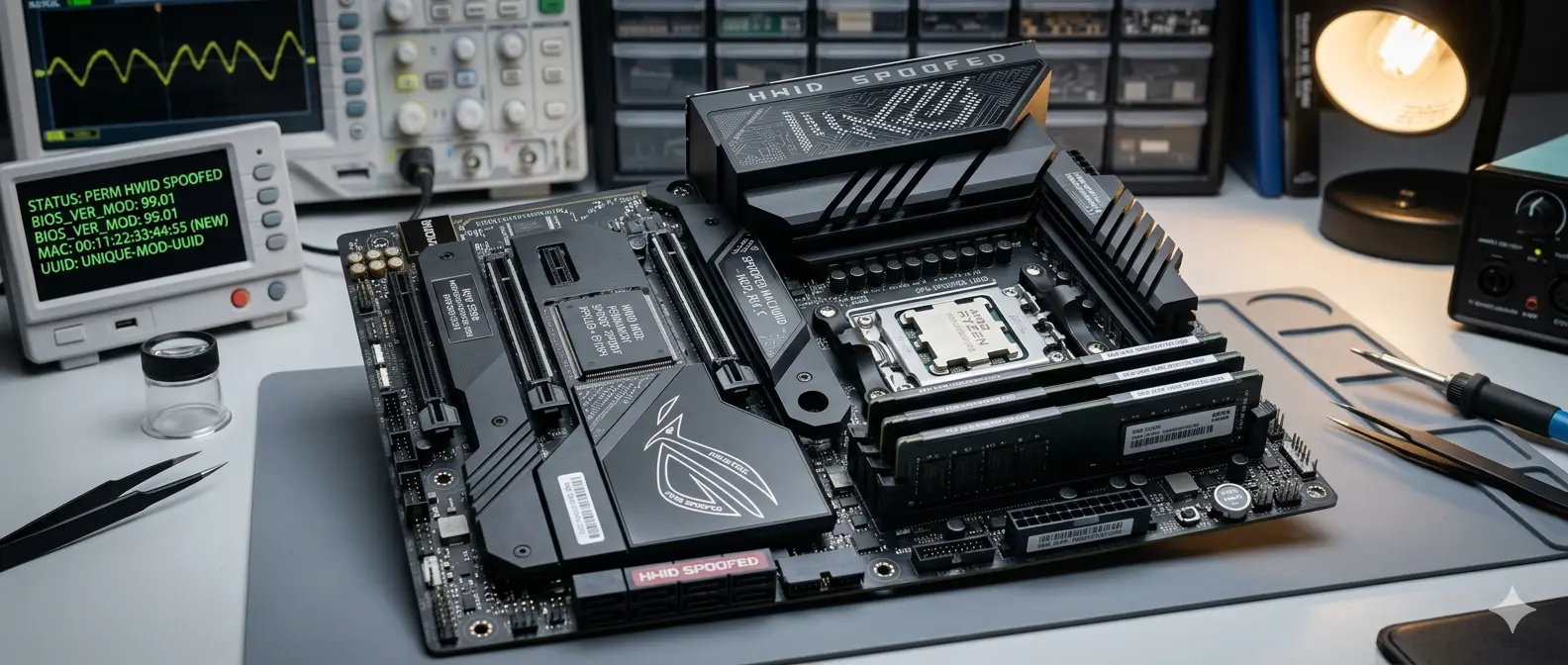
Permanent HWID Spoofers
Permanent HWID Spoofers: Advanced hardware identity manipulation that persists across system reboots and Windows updates. Discover how permanent spoofing differs from temporary solutions and provides lasting protection against hardware bans.
Permanent HWID Spoofers (Perm Spoofers) are elite-tier hardware identification manipulation tools that maintain spoofed hardware identifiers permanently across system reboots, Windows updates, and driver reinstallations. Unlike temporary spoofers that require re-application after each restart, permanent spoofers embed themselves deep into the system firmware and boot-level processes to ensure spoofed values persist indefinitely. The core concept revolves around modifying hardware identifiers at the lowest possible system level—BIOS/UEFI firmware, bootloader data, and kernel initialization routines—so that the operating system and all applications, including anti-cheat engines, perceive the spoofed hardware profile as the genuine configuration from the moment the system powers on. This creates a seamless, undetectable hardware identity that remains consistent regardless of system changes or security software scans.
The implementation of permanent spoofers involves sophisticated low-level techniques that go beyond standard kernel-mode drivers. Advanced perm spoofers utilize UEFI runtime services modification to alter serial numbers stored in firmware variables, ensuring that even BIOS-level queries return spoofed data. They employ bootkit methodologies to inject code during the early boot process, before Windows security mechanisms activate, allowing modification of hardware descriptors in ACPI tables, SMBIOS structures, and device firmware. Some implementations use direct SPI flash programming to permanently write spoofed identifiers into motherboard EEPROM chips, while others leverage EFI system partition modifications to execute spoofing routines during every boot cycle. The most advanced solutions combine secure boot bypass techniques, TPM state manipulation, and Windows Boot Manager hooks to create a multi-layered permanent spoofing environment that survives even clean Windows installations when the EFI partition remains intact.
The critical advantage of permanent spoofers is their set-and-forget functionality, eliminating the need for manual re-spoofing after system restarts or updates. This persistence is crucial for serious gamers and developers who require consistent hardware identity across multiple sessions without the risk of forgetting to reapply temporary spoofers. Permanent solutions also provide superior protection against anti-cheat systems that perform hardware checks at boot time or during system initialization, before usermode applications can execute. By operating at firmware and bootloader levels, perm spoofers remain invisible to kernel-level anti-cheat detection mechanisms that scan for driver signatures or suspicious memory modifications. Additionally, permanent spoofers typically include automatic randomization features that generate new hardware profiles on each boot while maintaining consistency within a single session, preventing anti-cheat machine learning algorithms from detecting repetitive patterns. This combination of persistence, stealth, and automation makes permanent HWID spoofers the gold standard for hardware ban evasion in competitive gaming and software testing environments.